

You know that sinking feeling when you search for something on Google, and instead of a list of websites, you just get a massive block of text written by a robot?
It answers the user’s question perfectly. And because it answers the question perfectly, nobody clicks on the websites below it.
For a regular person, that’s convenient. For those of us running websites or managing brands, it’s terrifying. We used to fight for the “Number 1” spot on Google. Now, we are fighting to just be mentioned inside that AI box.
This is the new reality of SEO. It’s messy, it’s unpredictable, and traditional tools like Ahrefs or SEMrush are struggling to keep up with it. They look at rankings; they don’t really look at what the AI is saying.
That is why I’ve started paying attention to Ziptie.
If you haven’t heard of it yet, you probably will soon. It’s a tool built specifically for this weird new era where Google (and engines like Perplexity) are generating answers rather than just listing links.
Here is why I think Ziptie is worth looking at if you want your brand to survive the AI shift.
It Sees What You Can’t (The “AI Overview” Blind Spot)
Here is the biggest problem right now: You might rank #1 organically for a keyword like “best running shoes.” Great, right?
But if Google’s AI Overview (that generative box at the top) pops up and recommends three other brands, your #1 ranking is basically invisible. You are winning a game that nobody is watching anymore.
Old-school rank trackers will tell you, “Congrats! You’re #1!” They give you a false sense of security.
Ziptie is different because it actually “looks” at the search results page to see if the AI is active. It tells you:
- If the AI is showing up for your keywords (it doesn’t show up for everything).
- What the AI is saying.
- If your site is cited as a source.
It’s like putting on a pair of glasses that lets you see the invisible layer of search traffic. Without it, you’re just guessing.
It Tracks Your “Share of Voice” in the AI
I was talking to a friend recently who runs a marketing agency. He was panicking because his client’s traffic dropped 20%, but their rankings hadn’t changed.
It turned out, the client’s competitors were getting all the love from the AI.
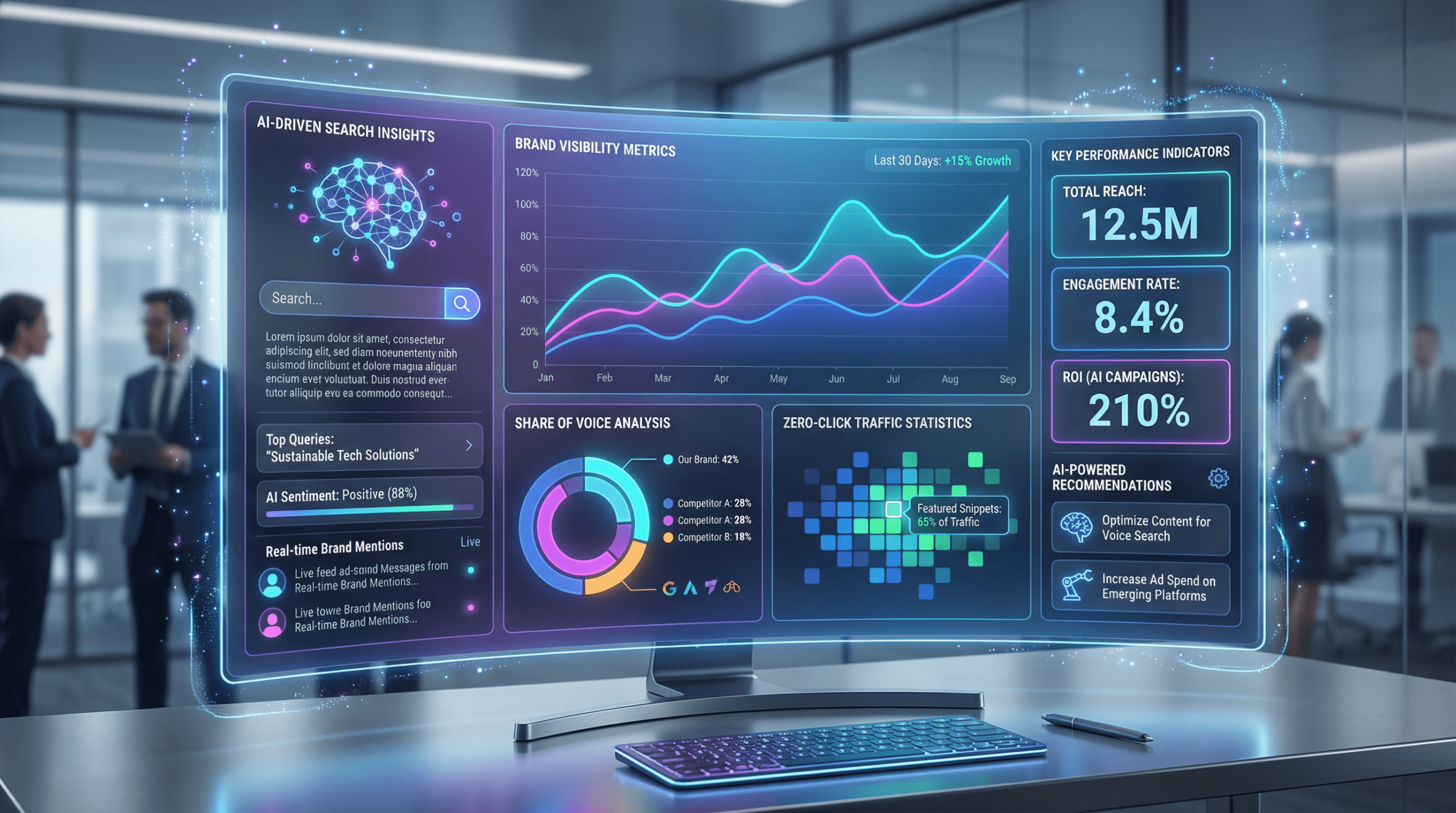
Ziptie has this feature that I honestly think is necessary for any modern brand. It measures your Share of Voice. Basically, it scans thousands of keywords and tells you, “Hey, out of 500 searches, the AI recommended your brand 150 times, but it recommended your competitor 300 times.”
This is huge.
It shifts the conversation from “how do we rank higher?” to “how do we get the robot to trust us?”
If you don’t know who the AI prefers, you can’t fix your content strategies. You might be writing great blog posts, but if they aren’t formatted in a way the AI likes to “read” and summarize, you’re invisible. Ziptie exposes that gap.
Protecting Your Traffic from the “Zero-Click” Black Hole
We need to be honest about something. Some keywords are just dead now.
If someone searches “how many ounces in a cup,” the AI answers it instantly. Nobody is clicking your cooking blog to find that out. That is a Zero-Click search.
Ziptie helps you identify which of your keywords are being cannibalized by the AI.
Why does this matter? Because it saves you time and money.
If you see that Google’s AI is dominating a specific topic and answering it fully, you can stop wasting money trying to write content for that keyword. You can’t beat the robot there. instead, you can pivot your strategy to more complex, nuanced topics where the AI doesn’t show up, or where it relies heavily on citing experts (like you).
It helps you pick battles you can actually win.
Understanding Why You Were Chosen (or Ignored)
This is the nerdy part, but I love it.
When the AI cites a website, it usually pulls a specific snippet of text. It’s like a college student writing a paper and grabbing a quote.
Ziptie allows you to see exactly which part of your content got picked up. This is gold for content optimization. You start to see patterns. You realize, “Oh, every time I use a bulleted list to summarize the answer at the top of the page, the AI cites me.”
Once you know the pattern, you can replicate it across your whole site. It’s a form of reverse-engineering the AI’s logic. You stop writing for humans only and start writing in a way that makes it easy for the machine to digest your info and serve it to the user.
Is It For Everyone?
Look, if you run a tiny local bakery and your only competition is the shop down the street, you probably don’t need Ziptie yet. Google Maps is still your best friend.
But if you are a:
- Publisher
- Affiliate marketer
- SaaS company
- E-commerce brand
Then yeah, you need to be looking at this. The search landscape is changing faster than I’ve ever seen it change in 15 years. We aren’t just optimizing for keywords anymore; we are optimizing for answers.
Ziptie isn’t magic. It won’t automatically fix your SEO. But it gives you the data you need to fix it yourself. In a world where everyone else is flying blind, having that data is a pretty massive advantage.
Frequently Asked Questions
Does Ziptie replace Ahrefs or Semrush?
Honestly? No. They do different things. Ahrefs is still king for backlink research and traditional keyword volume. Ziptie is a specialist tool for the “AI layer” of search. You probably need both if you’re serious about SEO.
Is it hard to use?
Not really. If you’ve used any rank tracker before, the interface will feel familiar. The data is different (trigger rates, pixel height of the AI box), but the dashboard logic is pretty standard.
Does it work for engines other than Google?
They are expanding fast. While Google’s “AI Overviews” (SGE) is the main focus because it has the biggest market share, the tech is designed to track how generative engines behave in general.
Is this “AI SEO” thing just a fad?
I doubt it. Google has bet its entire future on AI. They aren’t going to roll it back. The “10 blue links” era is fading, and hybrid search (links + AI) is the new normal. Tools like Ziptie are just the first wave of how we’ll manage this new normal.
