

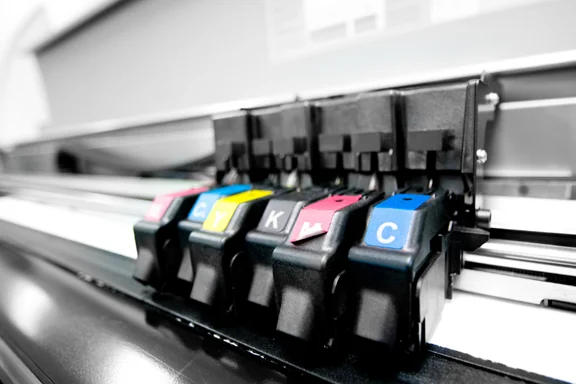
Printed materials shape how a brand is experienced outside digital spaces, and this can broaden your business’s audience. Systems that produce many formats in one workflow affect how steady and reliable brand assets appear across different touchpoints. Material type, size, and production control all shape how information is understood in physical settings. Here are a few ways that comprehensive printing services can elevate your brand image:
Strengthening Brand Visibility
Printing services produce a range of physical materials used for commercial communication; these include posters, banners, signage, menus, catalogs, books, and brochures. Large-format outputs support oversized applications used in displays and environmental graphics. Vinyl printing, canvas prints, decals, and wall graphics extend output into non-paper formats used on interior and exterior surfaces. These materials are used across retail environments for signage and visual presentation, such as:
- Fashion applications include lookbooks and printed collections used for presentation purposes.
- Hospitality settings use menus and printed informational materials for customer-facing functions.
- Events and exhibitions use banners, signage, and display graphics to support organized visual communication within venue spaces.
Large-format printing supports trade show displays and other scaled visual installations. Smaller formats, such as brochures, catalogs, and menus, support informational and operational communication needs. Vinyl and wall graphics can be applied to glass surfaces and display structures; this helps expand the range of placement options beyond traditional printed sheets.
Maintaining Brand Consistency
Printing services offer brand consistency through color, layout, and production output control within a single workflow. An in-house system keeps all stages under one structure, and this may reduce variation that appears when different providers handle separate production steps. Digital printing systems stabilize color reproduction so brand tones remain consistent across different materials and formats. Calibrated output avoids the shifts that happen when the ink, surface, or machine settings change between runs.
Enhancing Visual Impact
Large-format printing produces items like banners and signs. These items are printed in bigger sizes than normal prints, so the content is easy to see. They may be used when information needs more space to be displayed clearly. The process supports printed materials designed to stand out in physical spaces. These materials are often used in retail spaces, exhibitions, and events. Signs and banners act as the main display pieces in these areas.
Bigger prints can cover walls, entry areas, and main display points in a space. This helps the content stand out within busy environments that contain many visual elements. Large prints also help with reading content from a distance. Bigger surfaces allow text and images to stay clear from different viewing positions; this is useful in places where people move around and do not stay in one spot for long.
Building Brand Credibility
Printing services produce structured publication formats that help enhance a brand’s image and credibility; they include:
- catalogs
- portfolios
- brochures
- booklets
These formats organize content into multi-page printed forms that present information in structured layouts rather than isolated sheets. Catalogs and portfolios organize visual material into curated sequences that group related work into a unified presentation. Brochures and booklets condense information into shorter multi-page structures that still follow a defined layout progression. These formats introduce a level of structural completeness through page sequencing, binding, and layout continuity.
Streamlining Project Execution
Printing services accept print projects through digital upload, where files are submitted for production. This submission step starts the printing workflow and applies to incoming print jobs. A proof stage follows file submission and allows review of the uploaded file before printing begins. This step is used to check and confirm the file before production moves forward. Rush printing is available as an option for time-sensitive projects; it applies to print jobs that require faster turnaround. Files are submitted in print-ready format as part of the intake process, including PDF files prepared for production submission.
Use Printing Services
Professional printing services support consistent production quality that shapes how physical brand materials perform across different environments. Technicians manage file preparation, color calibration, material selection, proofing stages, and production sequencing to maintain alignment across outputs. These services help improve output reliability and reduce production errors, and they support stronger continuity across printed materials used in multiple formats. Contact a printing team today for controlled results for your project.
