

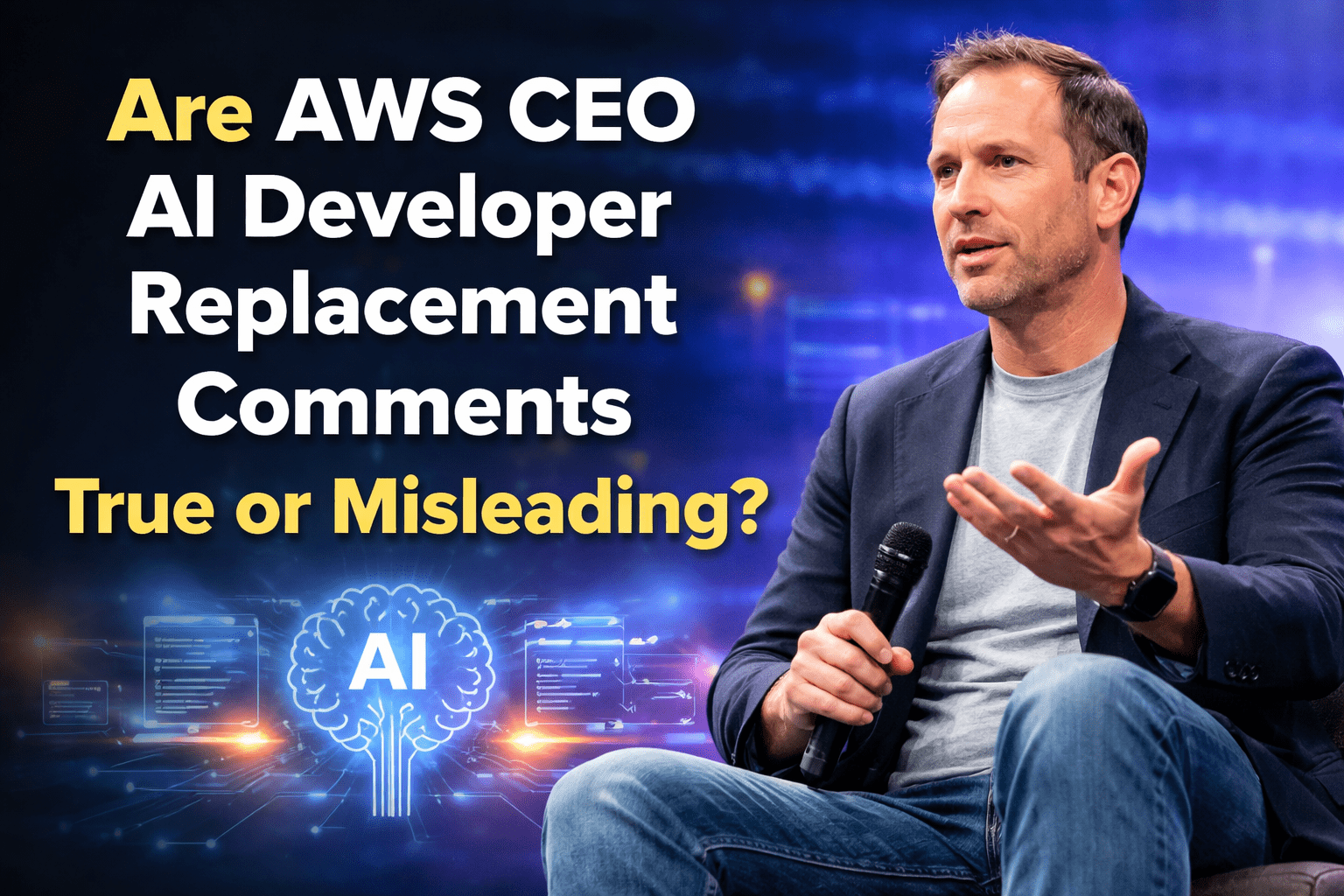
I’ll admit, when I first saw that phrase floating around — “AWS CEO AI developer replacement comments” — I raised an eyebrow. I’m not alone. A bunch of developers on Twitter and LinkedIn started sharing screenshots of what they thought was a quote about engineers being replaced by machines. Some sounded worried, others snarky, and a few downright scared for their jobs. But the funny thing? Once you dig in, the real story isn’t nearly as dramatic as the headlines made it seem.
Let’s unpack what really happened, what was actually said, and why so many people jumped to the worst possible interpretation.
Understanding the Context Behind the Comments
What Does “AI Developer Replacement” Even Mean?
When you hear “AI developer replacement,” it sounds intense, right? Almost like robots are lining up outside your office waiting to swipe your ID badge. But what that phrase really refers to is the idea that tools powered by machine learning could do the sort of coding tasks a junior engineer does — or even replace that person altogether.
It’s a topic that’s been buzzing forever now because tools keep getting better at autocomplete, debugging suggestions, and code generation. Some folks cheer it on, others worry about jobs. That mix creates a perfect storm for misinterpretation.
Who Is the AWS CEO and What Were His Comments?
The current CEO of Amazon Web Services — the massive cloud provider that powers everything from streaming services to enterprise apps — was asked about this very thing in an interview. The gist of what he said was something that caught a lot of people off guard: he referred to the idea that companies should just ditch junior developers in favor of machine-generated code as “one of the dumbest ideas I’ve ever heard” in tech.
Yes, it sounded blunt, but if you listen to the full quote, his point was less about fear and more about how vital people are to innovation.
This is where the phrase AWS CEO AI developer replacement comments started showing up all over headlines — but often without the full context.
Breaking Down the Statement
What Was Actually Said?
There’s no denying he used strong language. That’s what got everyone’s attention. But he wasn’t predicting doom and gloom. Instead, he pushed back against suggestions that human developers — especially early-career ones — could or should be simply swapped out for automated systems.
He pointed out something I think many seasoned developers instinctively know: you don’t grow great engineers by shrinking opportunities for them to learn on real projects.
Common Misinterpretations
Once that snippet spread on social media, the context got stripped. Someone might take that soundbite and turn it into a headline like:
“AWS CEO says AI will replace developers!”
Except he said almost the opposite. That kind of twist is exactly why so many devs were both confused and, in a few cases, outright angry.
The misunderstanding spread because fear sells clicks, and fear of job loss — especially in tech — resonates deeply.
Are the Comments True?
Fact Check: Statement vs. Interpretation
So let’s be clear: the AWS CEO AI developer replacement comments were real — he did talk about the idea. But the interpretation that he was warning humans would soon be obsolete? That’s not backed up by what he actually said.
He was critical of the notion that we should treat developers as interchangeable with AI tools. He wasn’t predicting mass layoffs or proclaiming that humans were going the way of typewriters soon.
What Industry Folks Think
Talking to a few engineers and tech leaders, I noticed a pattern. Most felt relief. Not because technology isn’t advancing — it absolutely is — but because someone at a big company finally acknowledged that building and maintaining software isn’t just about typing code. It’s about reasoning, design choices, understanding context, and yes, making mistakes and learning from them. No tool replaces that overnight.
Are the Comments Misleading?
Misleading Angles That Took Off
The biggest misleading angle was the assumption that any mention of automation and replacement means immediate job loss. That’s just not how most businesses operate. Tools change how we work before they make us irrelevant.
Another misleading twist was implying that the AWS CEO was anti-AI. Not true. His point wasn’t that automation is bad — it was that blindly replacing human roles without considering learning and growth is a poor strategy.
What Was Not Said
He didn’t say developers would never be impacted by automation. Nor did he suggest that cloud services aren’t investing heavily in smarter tooling. He just ruled out a simplistic view of letting AI do all the work while people stand aside.
That distinction matters, even if it doesn’t make for dramatic headlines.
What It Means for Developers
How New Tools Actually Affect Coding Roles
I remember early in my career when version control systems started taking over tedious merge tasks. Some people griped then too. Looking back? Those tools freed us to focus on real problems.
The same principle applies here. The goal isn’t to fire people. It’s to help people work smarter. Developers who embrace new tools tend to get more done and learn faster — not because the tools are magic, but because they let us skip drudge work.
Skills That Matter More Than Ever
Understanding architecture, communicating with teams, mentoring juniors — these things can’t be automated. And the more tools veer toward handling the repetitive stuff, the more those human skills shine.
Upskilling is real talk. If you’re a dev, sharpening your domain knowledge and problem‑solving ability will keep you relevant even as tools evolve.
Real-World Impact on Tech Jobs
Hiring and Salaries
I can’t promise you every company will expand hiring like crazy, but most won’t ditch human developers either. What is happening is a shift in the kind of work that gets valued. Routine tasks get automated first, and that nudges compensation patterns slowly upward for more strategic work.
How Developers Really Feel
A few friends of mine in the industry sounded this out, and it’s a mix. Some worry, sure. Big changes are intimidating. But a lot of devs are also excited — because they see tools as partners, not threats.
There’s a difference between feeling replaced and feeling augmented. I hear the latter more often.
Wrapping It Up
So, were the AWS CEO AI developer replacement comments true or misleading? They were both, but in different senses. He did make comments about the idea of replacing developers with tools. But the interpretation swirled into something he never actually said.
It’s not about being replaced. It’s about adapting, learning, and using the best tools we have without forgetting that the human mind still drives innovation.
If anything, this whole episode reminded me that people, creativity, and curiosity are still at the core of building great software — even in a world of smart tools.
FAQs
Did the AWS CEO actually say AI will replace developers?
No, he pushed back against that idea and emphasized the value of human developers.
Why are AWS CEO AI developer replacement comments controversial?
Because snippets shared online often stripped out context, implying threats that weren’t actually expressed.
Are AWS CEO comments about AI replacing developers misleading?
Yes, if taken out of context. The real message was more about strategy and learning than job elimination.
How should developers react to AWS CEO’s comments?
Stay curious, keep learning, and use tools to boost productivity without panic.
What did AWS CEO mean by comments on tools and coding jobs?
He meant that tools should help developers, not outright replace the human judgment and growth that make careers meaningful.
